
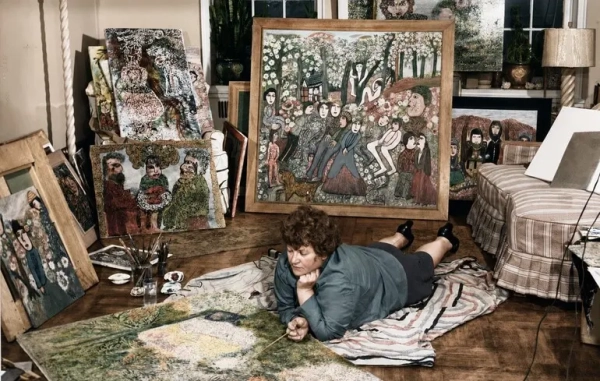
Janet Sobel works in her home studio in Brighton Beach, Brooklyn, 1944. In the background is the painting “Spring Festival” (1942) © Ben Schnall/courtesy Gary Snyder Fine Art. Colorization: ZN.UA

Author Petro Katerynych Doctor of Philosophy in Journalism, member of the National Union of Journalists of Ukraine and ECREA. Lecturer at the Educational and Scientific Institute of Journalism of Taras Shevchenko National University of Kyiv.
She created “all-over” compositions from splashed and poured paint even before drip painting became Jackson Pollock’s signature.
However, the world remembered him as a rebellious genius, while influential art critics dismissively called her a “housewife”.
The story of Janet Sobel (Olekhovska) — a Jewish refugee from Dnipro — is a story of an artistic revolution in which her role was underestimated for decades; about the gender bias of the art world and the artist’s belated return to history.
Imagine New York in 1946. Peggy Guggenheim’s Art of This Century gallery is the epicenter of the post-war avant-garde, the place where a new, bold American aesthetic was born. Two men stop in front of one of the small works. The first is the influential critic Clement Greenberg, a man whose word could make or break an artist. The second is the not yet famous, but already nervous and ambitious artist named Jackson Pollock.
On the canvas before them is a continuous lace of colored drips and smears covering the surface from edge to edge: without a center, without a top or bottom. This is what would later be called all-over painting. Greenberg would later admit: it was the first truly “all-over” painting he had ever seen. And Pollock, according to Greenberg, “admitted that these works impressed him.”
A few years later, Pollock would become a Life hero: in 1949, the magazine featured the provocative question, “Is He the Greatest Living Artist in the United States?” Later, the press would christen him “Jack the Dripper.” The name Janet Sobel, a mother of five and a Jewish refugee from Ukraine, would disappear from art history for decades.
Pogrom, Steamship, and Brighton Beach
Janet Sobel was born in 1893 in Yekaterinoslav (now Dnipro) as Jenny (Zhenya) Olekhovska. Her family belonged to the multi-million Jewish community that inhabited the cities and towns of then-Russian Ukraine — and lived under constant threat of violence.
This threat did not take long to materialize. Janet’s father, Baruch Olekhovsky, died during one of the pogroms — waves of anti-Jewish massacres that swept through the Russian Empire at the turn of the century. Her mother, Fanny Kinchuk, worked as a midwife. Left a widow with children in a country that offered them neither safety nor a future, she gathered her family and set off for overseas.
In 1908, still a teenager, Janet, along with her mother, brothers, and sisters, passed through Ellis Island — the main gateway of American immigration — and settled in Brighton Beach, a Jewish neighborhood in Brooklyn. At 16, she married Max Sobel, a native of Ukraine, a jeweler and engraver. The couple had five children.
For the next almost three decades, Janet Sobel was exactly what a woman of her class and era “should” be — a wife, mother, and homemaker.

Janet Sobel paints a vase in her studio, circa 1946
“If You Are So Interested in Art — Why Don’t You Paint?”
The story of how Sobel became an artist sounds almost like an anecdote, but it holds the key to her phenomenon.
In 1937, her son Saul, a gifted young man who had received a scholarship to the prestigious Art Students League, suddenly decided to quit painting. His mother tried to dissuade him. According to family lore, an irritated Saul challenged her: “If you are so interested in art, why don’t you paint yourself?”
Thus, 44-year-old Janet, who had never stood at an easel, gathered her son’s pencils and paints and allowed herself to simply begin. At first, she added something to his schoolwork, then worked on scraps of paper, cardboard boxes, on anything she could get her hands on.
Sobel’s early works are figurative and densely populated. They bring to life the world she brought with her across the ocean: lush floral ornaments of folk art, traditional Jewish families, soldiers with cannons, armies. It was a visual memory of Dnipro, filtered through the imagination of a woman who had already lived half her life in Brooklyn.

Janet Sobel next to her works, 1940s
Her talent was quickly noticed. Her son showed his mother’s works to the art emigration circle — and Sobel suddenly found herself in the orbit of the biggest names. Surrealists Max Ernst and André Breton admired her paintings; Marc Chagall knew and supported her.
Philosopher John Dewey, one of the most influential American thinkers of the 20th century, wrote a text for her exhibition at the Puma gallery in 1944. And the influential gallerist Sidney Janis noted: “Janet Sobel will likely one day be known as the most important Surrealist in this country.”
In the early 1940s, Sobel befriended Max Ernst — and it was he who introduced the artist to his then-wife, the gallerist Peggy Guggenheim. Her Art of This Century gallery was then the main venue for the New York avant-garde — the very one where, a few years later, Greenberg and Pollock would stop in front of Sobel’s canvas.

Janet Sobel. “Disappointment”, circa 1943. Oil and sand
The Philosophy of Chance: Art “from the Depths of the Soul”
What made Sobel so unusual for her time? Her method was more of a meditation than a technique.
She was self-taught. Sidney Janis, observing her evolution, wrote that the artist’s works were increasingly “surrendering to freedom and the play of imagination,” and her techniques, dominated by automatism and chance, were “improvised at the behest of inner necessity.” Sobel trusted her hand more than her plan: she poured paint, tilted the canvas, blew on wet lacquer, allowing the material to find its own form.

Janet Sobel. Untitled, circa 1952. Crayon on paper, 21.5 × 14 cm. Reproduction_ The Gallery of Everything
Ukrainian curator and art historian Alisa Lozhkina, author of the essay for the exhibition catalog “Janet Sobel: War,” notes: Sobel’s abstraction was not the result of a consistent evolution of modernist painting, as with most of her contemporaries. It grew from within — from memory, personal experience, and inner necessity, from the depths of the human soul itself. Senior MoMA curator Alex Galefeldt describes: “Sobel did it for herself, at home, for the pleasure of the process itself.”
This was her unconscious philosophy, resonating with Dewey’s ideas about the self-realization of the individual as the basis of democracy. For Sobel, art was a way of being herself. Her main goal, as researchers note, was visual intensity — and she achieved this intensity with striking regularity.
The paradox is that this very freedom — the absence of a school, the ambition to “enter history” — allowed her to be the first to cross the threshold that professionals hesitated at.

Janet Sobel. “Hiroshima”, circa 1948. Oil and enamel on canvas
The “Milky Way” That Led to Pollock
The method was almost alchemical and deeply domestic at the same time. Sobel spread the canvas on the floor of her Brighton Beach apartment and worked on it from above — splashing enamel with glass dropper pipettes, blowing on the paint, and sometimes even using a vacuum cleaner to draw the color across the surface.
The pinnacle of this period was a small 1945 work titled “Milky Way.” A shimmering, centerless field of colored drops that truly resembled a scattering of stars. Today, this painting is in the collection of the Museum of Modern Art (MoMA) in New York. And it was created even before drip painting became Jackson Pollock’s signature.

Janet Sobel. “Milky Way”, 1945. Enamel on canvas. Collection_ The Museum of Modern Art — MoMA, New York
There is a fundamental difference noted by researchers. In Pollock, the drip leads to pure abstraction; in Sobel, never completely. Even in her most “all-over” canvases, faces and small figures peek through the weave of colors: abstraction never fully displaced the human from her painting. Sobel moved freely between figuration and non-objectivity — sometimes within a single brushstroke.
In 1945, Peggy Guggenheim included Sobel in the group exhibition “Women” at her gallery, and the following year, she organized a solo exhibition for her. It was there that Greenberg and Pollock saw the artist’s works.
And it was Greenberg — the critic who had built Pollock’s cult for decades — who personally confirmed Sobel’s primacy: in the seminal essay “American-Type Painting,” he called her works the first “all-over” painting he had ever seen and added that they had impressed Pollock. The “godfather” of abstract expressionism inadvertently confirmed: at the beginning of this path stood a woman from Dnipro.
“Housewife”
The same Greenberg consistently ranked Sobel below Pollock — and did so using two words. He called her painting “primitive” and the artist herself a “housewife.”
These designations carried a double burden: both gender and class. Sobel lacked the “heroic scale” of Pollock’s canvases — she didn’t fit the myth being created around the New York School at the time — about brutal, drunken male geniuses like Pollock or de Kooning, splattering paint on enormous canvases.

Janet Sobel. Untitled (three figures among flowers), circa 1942
Newspapers reveled in the details of the artist’s domestic life and mockingly recounted how Janet enthusiastically treated the famous guest to a chicken she had baked herself. The men of the New York School were described as demiurges; Sobel as a hostess who had successfully roasted poultry.
In 1947, the family moved to Plainfield, New Jersey. After the move, Sobel almost gave up using enamel paints: according to accounts, she developed an allergy to one of the components. She continued to work with gouache and pencils, but the distance from New York and the break with the environment that had just begun to recognize her gradually pushed the artist out of the art world’s view.
In 1966, when Sobel was already bedridden, she was sought out by art historian William Rubin, who was researching Pollock’s work and would soon become a curator at MoMA. It was with his assistance that “Milky Way” entered the museum’s collection as a donation from the artist’s family.
Janet Sobel died in 1968 in Plainfield.
Return
Over the past decade, Sobel’s works have returned to major exhibitions: “Abstract Expressionism” at the Royal Academy in London (2016), “Women in Abstraction” at the Centre Pompidou in Paris (2021), and the retrospective “All-Over” at The Menil Collection in Houston (2024). In 2021, The New York Times published a belated obituary for the artist, and in 2022, the BBC published an article “Janet Sobel: The Woman Erased from History.”
For many years, Sobel was by inertia recorded as either a “Russian” or simply an “American” artist, erasing her roots — just as the origins of dozens of artists born on Ukrainian soil were erased.
In 2023, Rodovid Publishing, together with the Ukrainian Museum in New York, released the book “Janet Sobel: Wartime” — the first comprehensive Ukrainian conversation about the artist. In the same year, an exhibition of the same name opened in New York, curated by art historian Alisa Lozhkina and museum director Peter Doroshenko.

Janet Sobel. Untitled (soldiers with cannons), circa 1941
The exhibition focused on Sobel’s figurative works from 1941–1943. During those years, the artist followed the news of the war, tried to contact relatives who remained in Ukraine, but received no response. Two of her sons went to fight in Europe.
Sobel’s canvases from that period — disturbing, filled with soldiers, mothers, refugees — turned out to be eerily in sync with what Ukraine is experiencing today. It is no coincidence that contemporary Ukrainian artist Lesya Khomenko created the work AJS (After Janet Sobel), entering into a dialogue with her compatriot across centuries.
Janet Sobel lived two lives. In the first, she was a girl from Dnipro, whom pogroms and poverty cast overseas. In the second, a self-taught artist who developed her own method of “all-over” drip painting on the floor of her Brooklyn apartment — one of the techniques that would soon change post-war art. Now, a third life is underway — that of a prominent native of Ukraine, who, after decades of oblivion, is triumphantly reclaiming her rightful place in the avant-garde.